Quarterly News & Notes: Fall
2026
In this edition of News and Notes…
- Honoring the profession and celebrating newly certified internists on Internal Medicine Day
- Mark your calendars! Important certification and MOC dates
- Endocrinologists who demonstrate greater medical knowledge more likely to prescribe a recommended treatment for patients with Type 2 diabetes
- What should future assessments cover? Share your thoughts
- NEW: Have you seen Diplomates in the News?
- ABIM diplomates elected to National Academy of Medicine
- More personalized care, more focused assessment: One oncologist’s perspective
Celebrating Your Commitment to Our Profession

Today, October 28, is Internal Medicine Day—an opportunity to celebrate you: the community of nearly 300,000 ABIM Certified physicians who bring knowledge, skill and care to patients every day. Created by our colleagues at the American College of Physicians (ACP), it recognizes internists and internal medicine subspecialists and the many ways you strengthen the profession and make a difference in the lives of patients. Our Board of Directors Chair, Robert O. Roswell, MD, FACP, FACC, joined Jan K. Carney, MD, MPH, MACP, President of the ACP, to salute the contributions of physicians across our field. Click here to view their video message.
Every day, internists help patients navigate uncertainty, make difficult decisions and take steps toward better health. That work calls for exceptional medical knowledge and skill. It also takes compassion, perseverance, curiosity and a deep commitment to the people who place their trust in you. Today, we celebrate all that you bring to your patients, your colleagues and the profession.
This year, we are especially pleased to welcome 10,885 newly certified physicians to the ABIM community. They just received news of their exam scores last week, and we were thrilled to congratulate them. These newly certified physicians have reached an important moment in their careers, one built on years of training, learning, hard work and dedication to their patients.
They’ve demonstrated that they meet standards established by their peers and earned a distinction that reflects their commitment to the profession and to the patients they serve. We hope they take a moment today to feel proud of all they’ve accomplished, and we look forward to supporting them over the course of their careers.
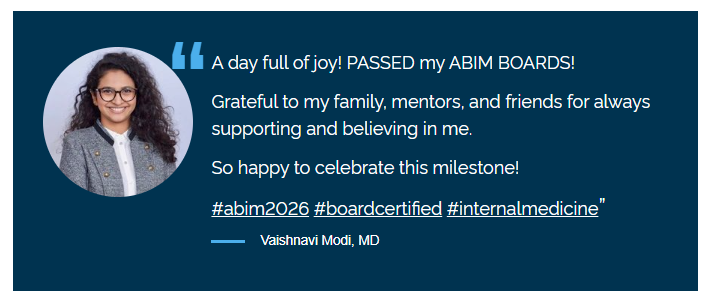
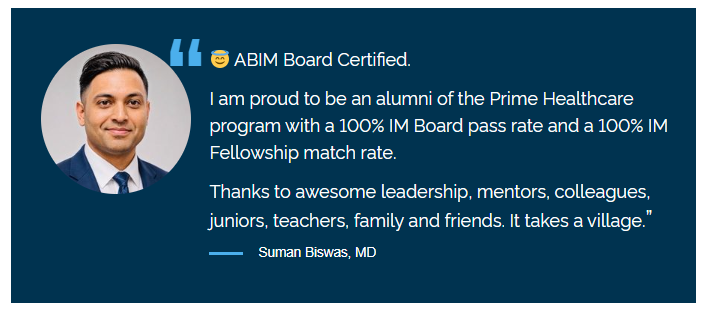
Read what becoming ABIM Certified means from a few newly certified physicians in their own words:
Whether you’re newly certified or have been in the profession for some time, we hope you’ll consider sharing your experience and perspective with ABIM in the year ahead—perhaps by helping write exam questions, serving on ABIM Governance or taking part in other opportunities to support the profession. The ABIM credential is stronger because of participation by peers.
On Internal Medicine Day, thank you for the knowledge, care and commitment you bring to your patients and to our profession. It is a privilege to be part of this community with you.
With gratitude,
Furman S. McDonald, MD, MPH, MACP
President and CEO
ABIM and the ABIM Foundation
Professor of Medicine
Mark your calendars! Important certification and MOC dates
Enrollment and Registration
December 1, 2026: Registration opens for all 2027 certification exams, and enrollment opens for all 2027 MOC assessments, including the new Clinical Cardiac Electrophysiology (CCEP) LKA®. (Learn what physicians are saying about the LKA.)
LKA-Related
November 15, 2026: Last day to enroll in the LKA for those with assessments due in 2026. (Enrolling at this time means you will have 10 “Life Happens” questions remaining over your five-year cycle.)
December 31, 2026: Last day to answer questions in the fourth quarter.
January 1, 2027: First-quarter LKA questions become available.
March 31, 2027: Last day to answer LKA questions in the first quarter.
April 1, 2027: Second-quarter LKA questions become available.
June 30, 2027: Last day to answer LKA questions in the second quarter.
July 1, 2027: Third-quarter LKA questions become available.
September 30, 2027: Last day to answer questions in the third quarter.
October 1, 2027: Fourth-quarter LKA questions become available.
November 15, 2027: Last day to enroll in the LKA in 2027.
Please see the ABIM policy on Testing Accommodations for Exam Takers with Disabilities.
Endocrinologists who demonstrate greater medical knowledge more likely to prescribe a recommended treatment for patients with Type 2 diabetes
Endocrinologists who scored highest on the American Board of Internal Medicine’s Longitudinal Knowledge Assessment (LKA®) were more likely to prescribe a key diabetes drug class following a treatment guidelines update compared to doctors with lower scores, according to findings published this week in JAMA Network Open.
In 2019, the American Diabetes Association (ADA) updated its Standards of Care to encourage prescribing sodium-glucose cotransporter-2 inhibitors (SGLT2i) and glucagon-like peptide-1 receptor agonists (GLP-1RA) for adults with Type 2 diabetes who are at high risk for cardiovascular disease, heart failure or chronic kidney disease.
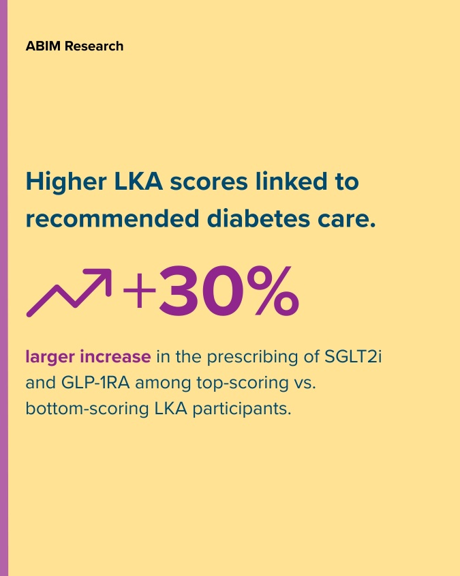
From 2018 (the year before the guideline update) to 2022, overall SGLT2i prescribing for patients with Type 2 diabetes targeted by the updated recommendations increased by 11.4 percentage points compared with patients not targeted by the recommendations. This comparative increase was 2.4 percentage points for GLP-1RA prescribing. The increase in SGLT2i prescribing was more than 30% larger among patients treated by endocrinologists with high (top quartile) first-year LKA scores compared with those with low (bottom quartile) scores. These score differences were not associated with increases in GLP-1RA prescribing.
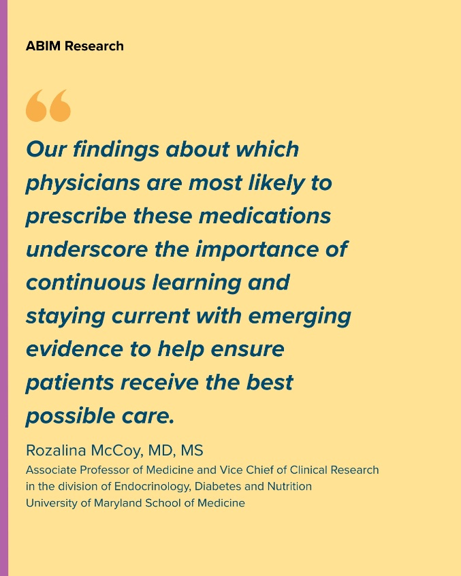
“These therapies can help prevent some of the most serious and costly cardiovascular and kidney complications of diabetes, including those that can lead to hospitalizations, disability and premature death. Yet even though they are widely recommended for high-risk patients, many who could benefit most from these drugs are not receiving them,” said senior author Rozalina McCoy, MD, MS, an endocrinologist, Associate Professor of Medicine and Vice Chief of Clinical Research in the division of Endocrinology, Diabetes and Nutrition at the University of Maryland School of Medicine. “Our findings about which physicians are most likely to prescribe these medications underscore the importance of continuous learning and staying current with emerging evidence to help ensure patients receive the best possible care.”
The findings join other newly published research examining possible connections between LKA participation and patient care among endocrinologists, which found that 95% of doctors surveyed reported learning while answering LKA questions. Sixty-eight percent said they were motivated to study by the real-time feedback they received through those assessments, and 53% reported that LKA participation resulted in changes or planned changes to patient care, according to findings published in August in Journal of the Endocrine Society.
What should future assessments cover? Share your thoughts
This fall, ABIM is asking physicians in several specialties—Adult Congenital Heart Disease, Endocrinology, Diabetes and Metabolism, Geriatric Medicine, Infectious Disease and Pulmonary Disease—to help shape what future assessments cover.
By completing a blueprint review, you can provide input on which topics are most important in your specialty and how much emphasis they should receive. Your feedback, along with input from medical specialty societies, helps inform the content of future certification and Maintenance of Certification (MOC) assessments, including the Longitudinal Knowledge Assessment (LKA®).
If you received an email inviting you to participate, we encourage you to complete the blueprint survey and tell us what knowledge matters most in your specialty. Your expertise will help shape the content and emphasis of future ABIM assessments and MOC points are awarded for this activity consistent with staying current in knowledge and practice, the purpose of continuing certification.
The Approval Committees and Specialty Boards that oversee assessment in these specialties will review the survey results and approve updated blueprints. New blueprints for each discipline will be published in January 2028.
The new blueprints will be used for the LKAs beginning in July 2028 and for the fall 2028 administrations of the certification and MOC exams.
Learn more about blueprints and blueprint reviews.
NEW: Have you seen Diplomates in the News?
Each week, we are sharing stories of ABIM Certified physicians featured in major news outlets highlighting their impact on the profession and the patients we care for. We recently highlighted two physicians who routinely contribute columns to national news outlets, lending their expertise and experience as board-certified physicians to important topics that are shaping medicine and the patient experience today.
What does it really mean to “trust your gut”?
What does it mean to have a “gut feeling,” and when should you listen to it? Trisha Pasricha, MD, MPH, ABIM Certified in Internal Medicine and Gastroenterology, explores these questions in her recent “Ask a Doctor” column in The Washington Post, where she writes and appears in videos several times a month.
Dr. Pasricha, a physician-scientist at Beth Israel Deaconess Medical Center and an Assistant Professor of Medicine at Harvard Medical School, examines how the connection between our brains and bodies can influence our intuition, explaining that chemical signals can alter the stomach’s electrical rhythm, producing what we experience as a “gut feeling.”

What does a “good death” look like?
In an opinion piece in The New York Times, Daniela Lamas, MD, who is ABIM Certified in Internal Medicine, Pulmonary Disease and Critical Care Medicine, shares how more than a decade of caring for patients in the ICU has shaped her perspective on end-of-life care.
Home hospice care can be deeply meaningful for both patients and families, but Dr. Lamas, a pulmonary and critical care physician at Brigham and Women’s Hospital, says that sometimes, intensive care is the right place to care for patients at the end of life.
“A death at home can be the right thing for a patient and his or her family. But it is not inherently better,” she wrote. “An ICU death can be peaceful and dignified. A death at home can be panicked and painful. Yet we have built a culture, and quality metrics, that treat ICU care at the end of life as a failure.”
Dr. Lamas has been writing for The New York Times for the past decade.
Read both of these features and more “Diplomates in the News” features on ABIM’s LinkedIn and Instagram. To tip us off about a story, contact Lindsay Durkalec in the Communications Department.

ABIM diplomates elected to National Academy of Medicine
Election to the National Academy of Medicine is considered one of the highest honors in health and medicine, recognizing individuals for their outstanding professional achievements and commitment to service. This year, 13 ABIM diplomates are among the 100 newly elected members, selected by their peers for their significant contributions to medical science, health care and public health.
ABIM proudly celebrates these diplomates for their dedication to advancing medical knowledge and serving the public:
- Lilia Cervantes, MD, MSCS, University of Colorado School of Medicine
- Ali Gharavi, MD, Columbia University
- Jeremy A. Greene, MD, Ph.D., Johns Hopkins University School of Medicine
- Roy S. Herbst, MD, Ph.D., Dartmouth Cancer Center and Geisel School of Medicine at Dartmouth College
- Nancy L. Keating, MD, MPH, Harvard Medical School
- Albert Icksang Ko, MD, Yale School of Public Health
- Bruce E. Landon, MD, MBA, Harvard Medical School and Beth Israel Deaconess Medical Center
- Anthony Letai, MD, Ph.D., National Cancer Institute
- Ross L. Levine, MD, Memorial Sloan Kettering Cancer Center
- Donald M. Lloyd-Jones, MD, ScM, Boston University Chobanian & Avedisian School of Medicine
- Kiran Musunuru, MD, Ph.D., MPH, ML, MRA, Perelman School of Medicine, University of Pennsylvania
- Katy Rezvani, MD, Ph.D., The University of Texas MD Anderson Cancer Center
- Dennis J. Slamon, MD, Ph.D., David Geffen School of Medicine at UCLA and UCLA Jonsson Comprehensive Cancer Center
More personalized care, more focused assessment: One oncologist’s perspective
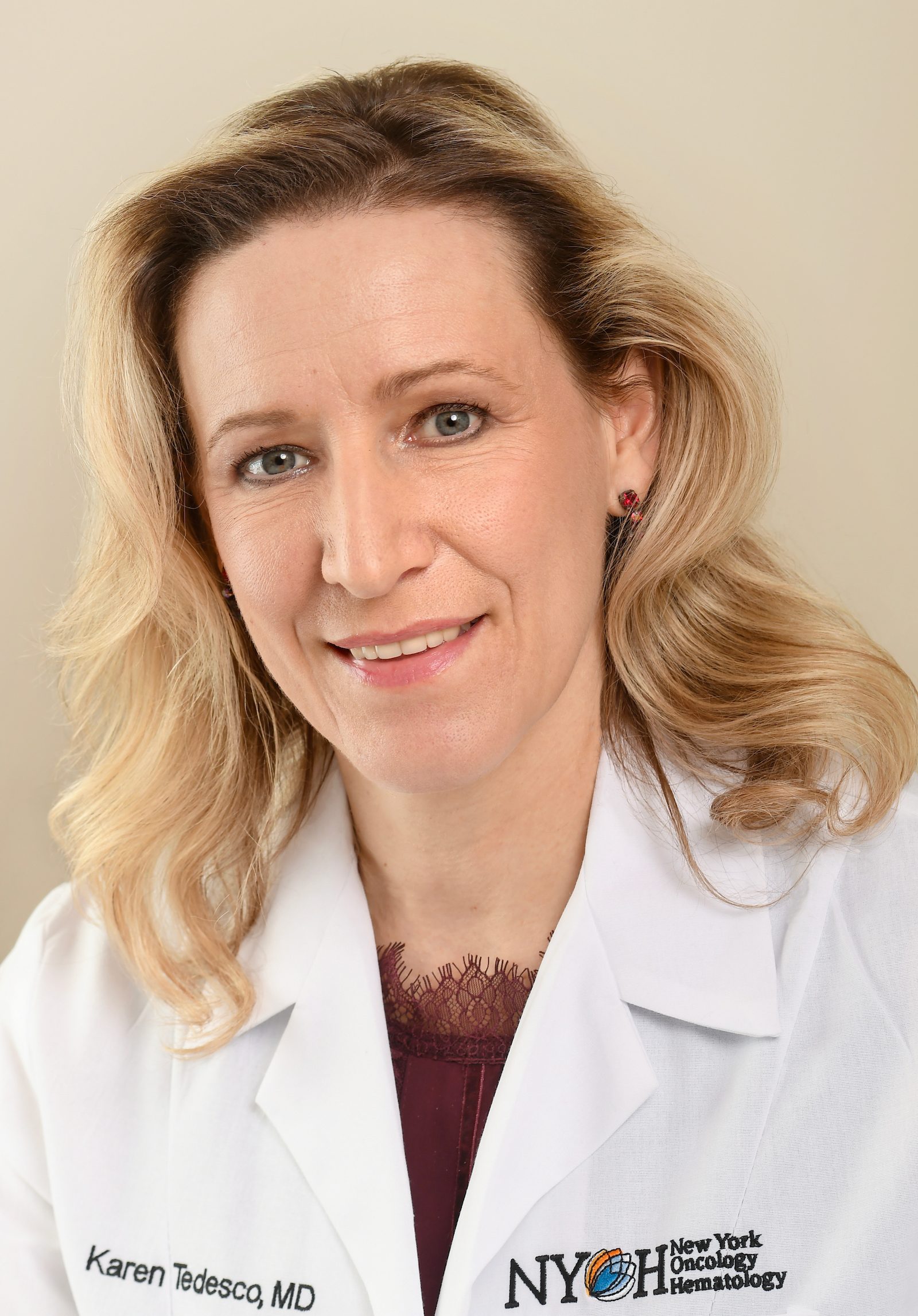
As Breast Cancer Awareness Month brings attention to advances in prevention, diagnosis and treatment, Karen Tedesco, MD, an ABIM Certified medical oncologist and hematologist who practices at New York Oncology Hematology in the Albany area, shared her perspective on how much has changed. Over 22 years in practice, she has seen a deeper understanding of breast cancer reshape how physicians care for their patients.
Dr. Tedesco was drawn to oncology by both the science and the relationships—the field’s strong foundation in research, as well as the opportunity to care for patients over time. Those two things have remained important to her as breast cancer treatment has become increasingly individualized.
“Breast cancer care has changed a lot, which is a great thing,” she said. “We understand more about breast cancer and the various subtypes and classifications that allow us to treat different patients differently so that we can individualize care more.”
In the past decade, new therapies have brought patients more options and better outcomes than ever before. The emergence of new inhibitor drugs, antibody-drug conjugates, immunotherapy and specialized drugs for patients with BRCA mutations have changed the landscape to make treating breast cancer increasingly personalized and precise. The pace of progress is unprecedented.
With that progress comes the ongoing challenge of keeping up with new evidence and advances in the field. For Dr. Tedesco, that made ABIM’s Medical Oncology Longitudinal Knowledge Assessment (LKA®) with Breast Cancer Focus a natural fit with her practice.
“I felt like it was the field in oncology that I’m most up to date on and probably see the most number of patients in,” she said. “When that became available as an option with ABIM, I thought that made sense for me.”
Designed for physicians whose practices are concentrated in breast cancer care, the focused assessment allows them to align more of their assessment experience with the patients and conditions they see most often.
For Dr. Tedesco, the LKA also feels more connected to how physicians learn and practice today.
“I think the current approach is a good one,” she said. “Participating in the assessments in a way that is more similar to how we would be functioning as physicians makes more sense and is more reflective of what we do in practice.”
The LKA with Breast Cancer Focus is one example of how ABIM is offering assessment options that align with the care physicians see in practice. The LKA is currently available in 16 disciplines, with the addition of the Clinical Cardiac Electrophysiology (CCEP) LKA launching in 2027. The LKA also includes focused assessment options in Gastroenterology (Hepatology Focus), Hematology (Classical or Nonmalignant Focus and Malignant Focus), Medical Oncology (Breast Cancer Focus and Hematologic Neoplasms Focus) and Sleep Medicine (Obstructive Sleep Apnea Focus).